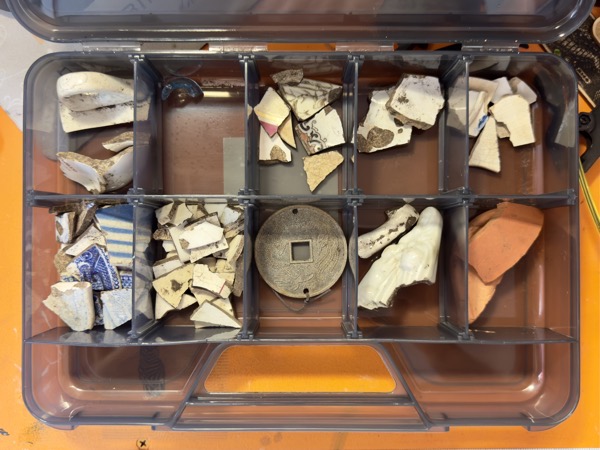
 There is a moment, just after your eyes learn what to look for, when the ground stops being ground.
It becomes an archive.
I am an artist, which is a practical way of saying I spend a great deal of my time looking down. At pavements. At turned earth. At the tideline where the last high water has combed everything into a neat, temporary line. Most people walk through a landscape.
I read it.
And what I read, more often than not, is pottery.
The Language of Sherds
If you live anywhere in Britain, you live on top of the Victorians. They broke a great many pots. They threw a great many things away. For more than a century we have built over, dug through and eroded their middens, drains and bottle dumps. The sea, the rivers and the allotment beds continue to return them to us.
At first glance it is just rubble. A bright white fleck in dark soil. A sliver of blue among the stones. Then your eye learns what it is seeing. That hard white is not chalk but ironstone. That blue is not a shell but transferware.
Once you recognise Victorian pottery, it becomes impossible not to see it. Five minutes into a walk and a handful of fragments begin to gather in your pocket, each carrying the beginning of a story.
There is the familiar Willow Pattern — that imagined landscape of bridges, pagodas and willow trees that found its way into countless homes. Even a fragment no larger than a coin can reveal the careful cross-hatching of a tree or the sharp geometry of a fence.
Then there is flow blue, where cobalt softened and drifted in the kiln until the pattern seemed to dissolve into itself.
The Victorians loved a controlled accident.
Turn a fragment over, and there is often another surprise. Proud maker’s marks. Registry diamonds. A lion and unicorn framing a name like Wedgwood, Copeland or Minton. Occasionally there is something quieter still: a worker’s initials scratched into the clay before firing.
Someone, perhaps a hundred and forty years ago, paused for a second and left the smallest trace of themselves.
These were never precious objects. They were washbowls, pie dishes, everyday plates and chipped mugs that served ordinary families before ending their lives behind a scullery or in a rubbish pit.
Perhaps that is exactly why I love them.
Why Found Objects Matter
People often imagine the pleasure lies in discovering something valuable.
It doesn’t.
If I wanted value, I would visit an antiques shop.
The joy of found objects is something altogether different. It is really three joys resting gently on top of one another.
The first is the joy of attention.
The world quietly rewards those who look closely. We live in an age that constantly asks us to look ahead, to look upwards, to look towards the next thing demanding our attention. To kneel in the mud and notice a broken fragment of pottery feels, somehow, like a small act of rebellion.
The second is the joy of connection.
When I pick up a piece of sponge-printed pottery from the late nineteenth century, I am not holding history in the abstract. I am holding something that sat on somebody’s kitchen table. Something washed after countless meals. Something dropped, swept away and forgotten.
It is Tuesday afternoon history.
The distance between their life and mine suddenly becomes astonishingly small.
The third joy is possibility.
A found object is unfinished. That is its gift.
On the shoreline or in a field, it is simply discarded. In the studio it becomes material waiting to discover what it might become.
Perhaps this is why broken pottery speaks to me so strongly.
Every fragment carries the outline of something absent.
The missing pieces matter just as much as the ones we find. They remind us that absence has a shape of its own.
From Foreshore to Studio
I don’t collect these fragments to display them.
I collect them to work with them.
The process begins on the studio floor. I empty a tin and simply begin arranging. A curved rim beside a sharp edge. Half a maker’s name beside the painted face of a forgotten figurine. A delicate Willow bridge resting against an unassuming piece of salt-glazed stoneware.
I don’t plan.
I listen.
The fragments gradually begin finding one another.
Victorian pottery was designed to cover every available surface with decoration. Once broken apart, those intricate patterns become something unexpectedly modern. Time has already created the collage. I simply continue the conversation.
Some pieces become assemblages. Others disappear into plaster so they appear freshly excavated. Sometimes I mount them onto reclaimed timber, where weathered grain and crazed glaze seem to speak the same language.
Restoring the original pot has never interested me.
The break is the story.
The softened edges shaped by water. The chip where somebody’s hand slipped. The fingerprint trapped forever beneath the glaze. The three tiny stilt marks left by the kiln.
These are not imperfections.
They are biography.
People often ask whether I clean what I find.
I wash away the mud.
Nothing more.
A little river silt still caught in the glaze, or the faint stain left by the tide, tells part of the object’s journey. To scrub those traces away would be to pretend they had never existed.
Learning to See
If you have never picked up a found object, you already possess everything you need.
Only curiosity.
Perhaps one day you will find yourself walking across a freshly ploughed field after rain, or wandering along a beach after a winter storm. Perhaps you’ll pass an old allotment where generations once gardened.
If you do, slow down.
Look for the white.
Then the blue.
Most fragments are happy to remain where they have rested for decades. Leave those for someone else.
But every so often one will quietly ask to come home with you.
It might be a single letter.
A flower.
A corner of pattern.
Something will make your heart give the smallest of thumps.
The thump is the only curation you need.
Take it home.
Wash it gently.
Leave it on a windowsill for a while.
Without really noticing, you will begin to place one beside another. This blue belongs with that green. This fragment of text seems to want to sit beside that weathered face.
The artwork has already begun.
You did not invent it.
You simply recognised it.
There is so much in the world that is new, polished and impatient for our attention.
Found objects whisper.
Victorian pottery, with its lions, garlands and endless blue willows, has been whispering beneath our feet for well over a century.
It is a quiet joy to kneel down and listen.
And then, because I am an artist and cannot help myself, to answer back with glue and grout, reclaimed wood and time, allowing beautiful, broken things to become something whole once again.
Not by erasing their fractures—
but by letting them remain visible.
Leave a Reply